The Symbolism of Snakes in Saivism
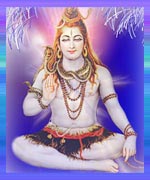
Lord Siva is depicted in many images like the one above as wearing a garland of snakes around his neck. There is a deep symbolism hidden behind this.
Lord Siva is know as Pasupathinath, the lord of all creatures. Being a lord of the animals he has complete control on their behavior. Since a snake is one of the most feared and dangerous animals in the world, the garland of snakes around the neck firmly establishes this fact even the snakes fear Him and remain under his control.
The snake stands for all the evil and demonical nature in the world. By wearing the snake around his neck, Lord Siva gives us the assurance that no evil can touch us or destroy us once we surrender to him, seek his protection and worship him with deep devotion.
The snake also stands for the power of kundalini, which is described as a coiled serpent lying dormant in the muladhara chakra of all human beings and descends upwards when one starts ones spiritual journey and becomes increasingly divine oriented. The snake around the neck of Siva conveys the meaning that in him the kundalini not only has arisen fully but is also actively involved in the divine activity by keeping an eye on all the devotees who approach Siva with their individual problems.
The snake also stands for all passions and desires. By wearing the snakes around his neck, Lord Siva conveys the message to all his devotees that He has overcome all desires and is in full control of Prakriti, or maya and its various machinations.
SHIVA
Shiva is believed to exist in many forms. His most common depiction is as a dark-skinned ascetic with a blue throat, usually seated cross-legged on a tiger skin.
Shiva’s hair is matted and coiled on his head, adorned with a snake and a crescent moon. Ganga is always depicted flowing out of his topknot. Shiva has four arms and three eyes. The third eye, in the middle of his forehead, is always closed and only opens to annihilate an evil doer. A garland of skulls, rudraksha beads, or a snake hang from his neck. Shiva also wears snakes as armlets and bracelets. The serpent race, despised and feared by all other creatures, found a place of honour on Shiva’s sacred person, simply because he was moved by their plight.

In one hand, Shiva holds his trishul, the Pinaka. The trishul usually has a damaru or waisted drum tied to it. In another hand, he holds a conch shell and in the third, a rudraksha rosary, a club, or a bow. One hand is usually empty, raised in a gesture of blessing and protection. The other points to his feet, where the devotee is assured of salvation. He wears a tiger or leopard skin around his waist, and his upper body is usually bare, but smeared with ashes, as befits an ascetic. His third eye is believed to have appeared when Parvati, in a playful mood, covered his eyes with her hands. Immediately, the universe was plunged into darkness and there was chaos. To restore order, Shiva formed another eye on his forehead, from which emerged fire to restore light.
The light from this eye is believed to be very powerful, and therefore destructive. Shiva opens his third eye only in anger, and the offender is burnt to cinders.
The name Shiva does not appear in the Vedas. However he is identified with the Vedic god Rudra, lord of songs, sacrifices, nourishment, the healer of diseases and provider of property. According to the Shiva Purana, Shiva is said to have five faces, corresponding to his five tasks, the panchakriya: creation, establishment, destruction, oblivion, and grace. His five faces are associated with the creation of the sacred syllable Om.
SHIVA
Shiva literally means “auspiciousness, welfare”. He is the third god of the Hindu Triad and is the destroyer of all evil. He represents darkness (tamas), and is said to be the ‘angry god’. However, according to Hinduism, creation follows destruction. Therefore Shiva is also regarded as a reproductive power, which restores what has been dissolved. As one who restores, he is represented as the linga or phallus (Shivalinga), a symbol of regeneration.
He has a 1,008 names, including Mahadeva (the great god), Mahesh, Rudra, Neelkantha (the blue-throated one), and Ishwar (the supreme god). He is also called Mahayogi, or the great ascetic, who symbolises the highest form of austere penance and abstract meditation, which results in salvation.
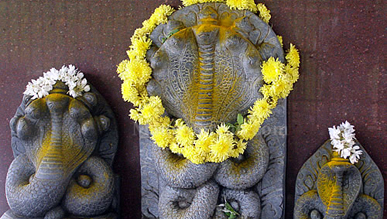
 The Nag Panchami is a festival that celebrates the mystifying role of snakes, namely the cobra, in Hindu mythology. While there are numerous stories and legends that surround the origin of this custom of honoring snakes, the main binding element in all these versions, is the worship and respect of these elegant, yet, fearful creatures. Nag Panchami celebrated on the fifth day, panchami, of the Hindu month of Shravan.
NAG PANCHAMI
The Legend
In ancient India, there lived a clan by the name of "NAGAS" whose culture was highly developed. The Indus Valley civilisation of 3000 B.C. gives ample proof of the popularity of snake-worship amongst the Nagas, whose culture was fairly wide-spread in India even before the Aryans came. After the Naga culture got incorporated into Hinduism, the Indo-Aryans themselves accepted many of the snake deities of the Nagas in their pantheon and some of them even enjoyed a pride of place in the Puranic Hinduism.
The prominent Cobra snakes mentioned in the Puranas are Anant, Vasuki, Shesh, Padma, Kanwal, Karkotak, Kalia, Aswatar, Takshak, Sankhpal, Dhritarashtra and Pingal. Some historians state that these were not snakes but Naga Kings of various regions with immerse power.
The thousand-headed Shesh Nag who symbolises Eternity is the couch of Lord Vishnu. It is on this couch that the Lord reclines between the time of the dissolution of one Universe and creation of another. Hindus believe in the immortality of the snake because of its habit of sloughing its skin. As such Eternity in Hinduism is often represented by a serpent eating its own tail.
In Jainism and Buddhism snake is regarded as sacred having divine qualities. It is believed that a Cobra snake saved the life of Buddha and another protected the Jain Muni Parshwanath. To-day as an evidence of this belief, we find a huge serpent carved above the head of the statue of Muni Parshwanath. In medieval India figures of snakes were carved or painted on the walls of many Hindu temples. In the carves at Ajanta images of the rituals of snake worship are found. Kautilya, in his "Arthashastra" has given detailed description of the cobra snakes.
Fascinating, frightening, sleek and virtually death-less, the cobra snake has always held a peculiar charm of its own since the time when man and snake confronted each other. As the cobra unfolded its qualities, extra-ordinary legends grew around it enveloping it in the garble of divinity. Most of these legends are in relation with Lord Vishnu, Shiv and Subramanyam.
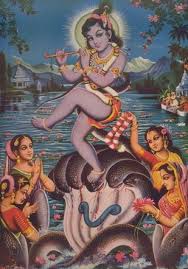
The most popular legend is about Lord Krishna when he was just a young boy. When playing the game of throwing the ball with his cowherd friends, the legend goes to tell how the ball fell into Yamuna River and how Krishna vanquished Kalia Serpent and saved the people from drinking the poisonous water by forcing Kalia to go away.
It is an age-old religious belief that serpents are loved and blessed by Lord Shiv. May be therefore, he always wears them as ornamentation around his neck. Most of the festivals that fall in the month of Shravan are celebrated in honour of Lord Shiv, whose blessings are sought by devotees, and along with the Lord, snakes are also worshiped. Particularly on the Nag-Panchami day live cobras or their pictures are revered and religious rights are performed to seek their good will. To seek immunity from snake bites, they are bathed with milk, haldi-kumkum is sprinkled on their heads and milk and rice are offered as "naivedya". The Brahmin who is called to do the religious ritual is given "dakshina" in silver or gold coins some times, even a cow is given away as gift.